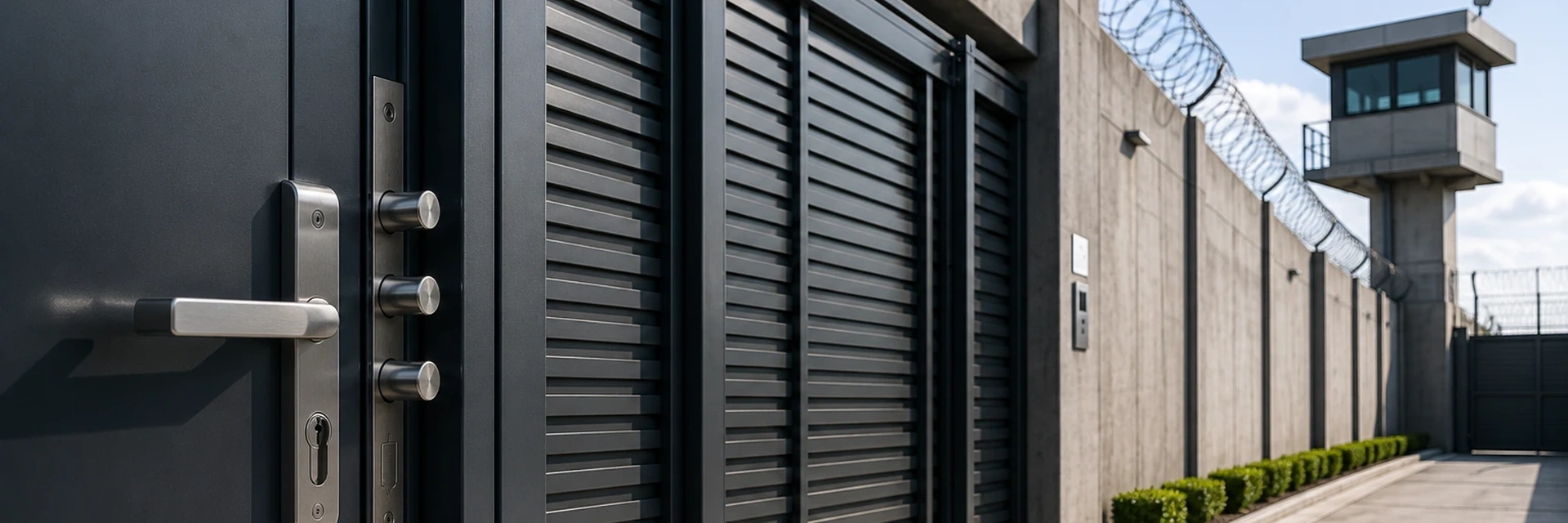



A tender specification states, "Provide LPS 1175 rated entrance doors." Another project calls for "UL rated security doors." Beyond these brief references, there's often little explanation of what the ratings mean or how they influence product selection. For architects, security consultants, procurement teams, and contractors working on high security facilities, interpreting these requirements correctly is essential to delivering a compliant and effective security solution.
The confusion often arises because LPS 1175, UL, and EN 1627 are frequently discussed together or assumed to measure the same level of protection. In reality, each standard has a different purpose, testing methodology, and regional relevance. Some evaluate resistance to forced physical attacks, while others focus on ballistic threats or different aspects of physical security. Selecting the wrong standard can lead to specification errors, unnecessary costs, or products that fail to meet project requirements.
This guide explains forced entry resistance standards in practical, easy to understand terms. You'll learn what LPS 1175, UL, and EN 1627 measure, how they differ, where they're commonly specified across the UAE, Oman, and the GCC, and how to select the right security rating for government buildings, banks, data centres, and other high security facilities.
What Forced Entry Resistance Actually Means
Forced entry resistance refers to a door, window, shutter, or other physical security system's ability to resist deliberate attempts at unauthorised access using manual or powered tools. Rather than measuring the strength of a single material, recognised forced entry resistant door standards evaluate the performance of the complete assembly under controlled testing conditions.
This means certification applies to the entire system, including:
- Door leaf or shutter
- Frame and anchoring system
- Locking mechanism
- Hinges and hardware
- Glazing, where applicable
- Installation configuration used during testing
During certification, accredited testing bodies simulate realistic attack scenarios using specified tools and test procedures. The objective is to determine whether the complete assembly can resist forced entry for the requirements defined by the applicable standard. The result is an independently verified security rating rather than a manufacturer's performance claim.
It is equally important to understand what forced entry resistance does not mean.
A door certified against forced entry is not automatically:
- Ballistic resistant against firearm threats.
- Blast resistant against explosive pressure and structural loading.
- Certified for every type of physical security threat.
These are separate engineering disciplines with their own testing standards and certification requirements. As a result, a single entrance in a government building, embassy, financial institution, or data centre may require independent certifications for forced entry, ballistic protection, and blast resistance depending on the project's risk assessment and specification.
Assuming one certification satisfies another is one of the most common specification errors. It can lead to compliance issues, redesigns, unnecessary expenditure, or security gaps that only become apparent during project review or commissioning.
Two standards are referenced more frequently than any others when specifying forced entry resistance: LPS 1175 and UL. While both contribute to physical security, they differ in scope, testing philosophy, and application. Understanding these distinctions begins with one of the world's most widely recognised forced entry standards, LPS 1175.
LPS 1175 Explained
LPS 1175 is one of the most widely recognised forced entry resistance standards for physical security products. It is developed by BRE Global, with certification administered by the Loss Prevention Certification Board (LPCB).
Rather than measuring the strength of an individual material, LPS 1175 evaluates how well a complete security assembly resists a deliberate attack. During testing, accredited laboratories attempt to breach the product using a defined set of tools within a specified testing methodology. The objective is to determine whether an intruder can gain unauthorised access under controlled conditions, making the rating a measure of tested performance rather than perceived durability.
Products that successfully complete testing are assigned a Security Rating (SR), ranging from SR1 to SR8. In general, higher SR ratings indicate resistance to increasingly sophisticated attack methods and greater levels of security. As testing requirements are periodically updated, the exact tool categories and attack durations should always be verified against the latest BRE Global and LPCB publications before being referenced in project specifications.
One important point that is often overlooked is that LPS 1175 certifies the complete assembly, not individual components. The door, frame, locking hardware, hinges, glazing, and associated fixings are tested together as a single system. A door manufactured from a high strength material does not automatically achieve LPS 1175 compliance unless the entire assembly has been tested and certified in that configuration.
When evaluating suppliers, avoid relying on broad statements such as "LPS 1175 certified." A genuine certification should clearly identify the Security Rating (SR) achieved and be supported by a valid certificate or accredited test house reference. This provides specifiers with confidence that the product has been independently tested and certified for the intended level of protection.
UL 752 Explained
UL (Underwriters Laboratories) is a US based safety science and certification organisation, and UL 752 is its widely recognised standard for bullet resisting equipment.
Its primary purpose is to evaluate how security products such as doors, windows, glazing, partitions, and transaction systems perform when subjected to ballistic threats. In other words, UL 752 is principally a ballistic resistance standard, not a forced entry resistance standard. Establishing this distinction early is important because the two are frequently confused during product specification.
UL also publishes related standards covering burglary and forced entry resistance for specific product categories, including vault doors and safes. These requirements generally fall under separate UL standards, commonly referenced as UL 608 for burglary resistant vault doors, rather than UL 752 itself. Although these standards all contribute to physical security, they address different threat scenarios and should not be used interchangeably.
This distinction is often overlooked. Many supplier websites and competitor pages incorrectly describe UL 752 as a forced entry or burglary resistance standard, when its primary scope is ballistic protection. Relying on these claims without verifying the applicable standard can lead to specification errors and products being selected for threats they were never tested to resist.
Before referencing any UL standard in project documentation, always verify the current standard number, scope, and testing methodology against UL's official published standards. As UL periodically updates its standards and product categories, the latest published documentation should always be used during specification and procurement.
LPS vs UL vs RC (EN 1627): Key Differences
While LPS 1175 and UL are widely recognised in UK and US influenced projects, EN 1627 is the European standard for burglary resistance. It uses Resistance Classes (RC1 to RC6) and follows a similar principle of evaluating products against defined attack methods, tools, and testing conditions, although the classification system differs from LPS 1175.
| Standard | Issuing Body | Primary Region of Use | Rating Scale | What It Tests |
|---|---|---|---|---|
| LPS 1175 | BRE Global / LPCB | UK and international projects | SR1 to SR8 | Forced entry resistance |
| UL 752 | UL (Underwriters Laboratories) | United States and international projects | UL Levels | Bullet resistance |
| EN 1627 | European Committee for Standardization (CEN) | Europe and European specified projects | RC1 to RC6 | Burglary resistance |
The exact performance requirements, tool categories, attack durations, and testing methodologies for each rating should always be verified against the latest official publications issued by BRE/LPCB, UL, and CEN before being referenced in project documentation.
A common mistake is assuming that ratings across different standards are directly comparable. Online charts claiming that an SR3 is equivalent to a particular UL Level or RC rating are not authoritative and should never be used for compliance or specification decisions. Each standard has its own scope, testing methodology, and performance criteria, making direct conversions unreliable.
If a project specification references multiple standards or appears ambiguous, the correct professional approach is to seek clarification from the security consultant, specifier, or authority having jurisdiction (AHJ) rather than assuming an equivalent rating. This helps ensure the selected product meets the project's intended security requirements and complies with the applicable certification standard.
Which Standard Applies in the GCC?
There is no single default security standard across the GCC. Instead, project specifications are often influenced by the background of the consultant, client requirements, regulatory expectations, and the nature of the facility being protected.
Projects led by UK or European trained consultants commonly reference LPS 1175 or EN 1627, particularly where independently tested forced entry or burglary resistance is required. By contrast, US influenced government, defence, diplomatic, and banking projects are more likely to specify UL standards, especially where ballistic protection forms part of the security brief.
For architects, contractors, and procurement teams, the most important step is not to assume which standard applies based on the project type or location alone. Instead, always review the tender documents carefully and confirm which certification has been specified by the consultant, client, or authority having jurisdiction (AHJ), such as a central bank, government security directorate, or other approving authority. This helps avoid costly specification errors, procurement delays, and compliance issues during project delivery.
From a procurement perspective, it is also beneficial to work with a manufacturer that can supply products, supporting documentation, and certification pathways aligned with the required framework rather than being limited to a single standard. With manufacturing facilities in Sharjah and its headquarters in Oman, Dosteen supports projects across the GCC with security solutions designed to meet a wide range of regional specification requirements without being tied to one certification approach alone.
How to Choose the Right Security Rating
Choosing the appropriate forced entry resistance standard starts with understanding the project's security objectives rather than simply selecting the highest available rating.
Identify the asset being protected and its level of risk.
Consider what the opening protects, whether it is a data centre, cash handling area, government office, or critical infrastructure, as this forms the basis of the required level of protection.
Determine who governs the specification.
Review the client's security policy, insurer requirements, consultant specifications, or government mandates to identify which certification standard must be met before selecting a product.
Confirm whether forced entry is the only security requirement.
Some projects require additional protection against ballistic threats or blast events, meaning separate certifications may be needed for the same door or window system.
Select a rating that reflects the realistic threat and expected response time.
The required level of protection should align with the anticipated attack risk and the time available for security personnel or emergency responders to intervene.
Verify the supplier's certification before procurement.
Request current certificates, product specific test reports, and accredited test house references to confirm that the proposed solution has been independently certified for the required standard.
Following these steps helps ensure security products are selected based on verified performance, regulatory compliance, and the actual risk profile of the facility rather than assumptions or marketing claims.
Common Misconceptions
- A high forced entry rating means the door is also bullet resistant.
Forced entry resistance and ballistic resistance are evaluated under separate standards. A product must be independently tested and certified for each applicable threat. - Security ratings from different standards are directly interchangeable.
LPS 1175, UL, and EN 1627 use different testing methodologies, rating systems, and certification criteria. Equivalence should never be assumed without official guidance. - A supplier's certification claim is enough to confirm compliance.
Always request the relevant certificate, Security Rating or classification, and accredited test house reference to verify that the product has been independently tested. - Choosing the highest rating always provides the best solution.
Over specifying can increase project costs without delivering meaningful additional protection. The most appropriate rating is the one that aligns with the project's risk assessment, regulatory requirements, and operational needs.
How Dosteen Approaches High Security Projects
Dosteen supports projects requiring specialised physical security solutions by manufacturing products for applications including security shutters, blast resistant doors and windows, vault doors, and mantrap access control systems. Product selection is guided by project specifications and the applicable certification requirements rather than a one size fits all approach.
To support architects, consultants, and contractors during design and procurement, Dosteen provides CSI specifications and BIM ready documentation, helping security requirements be accurately incorporated into project documentation from the early design stages.
With more than 25 years of engineering experience, a manufacturing facility in Sharjah, and headquarters in Oman, Dosteen supports projects across the GCC with locally manufactured security solutions backed by technical documentation and project specific engineering support. This enables consultants and procurement teams to specify products that align with the required certification framework while maintaining consistency throughout design, approval, and installation.
Frequently Asked Questions
1. What does "forced entry resistant" mean for a door or window?
A forced entry resistant door or window is designed and independently tested to resist deliberate attempts at unauthorised access using specified attack methods. Certification applies to the complete assembly rather than a single component.
Testing evaluates the performance of the door or window, frame, locking system, hardware, glazing, and fixings under controlled conditions. The objective is to determine whether the system can delay or prevent forced entry for the requirements defined by the applicable standard.
2. What is LPS 1175 and who issues it?
LPS 1175 is a UK security standard used to evaluate forced entry resistance for physical security products. It is developed by BRE Global, with certification administered by the Loss Prevention Certification Board (LPCB).
Products are tested using defined attack methods before being assigned a Security Rating (SR). Certification applies only to products that successfully meet the standard's testing requirements.
3. What does an SR rating mean in practical terms?
An SR (Security Rating) indicates the level of forced entry resistance achieved by a product during LPS 1175 testing. Higher SR ratings generally represent increased resistance to more demanding attack scenarios.
The rating should always be considered alongside the product's certification documentation, as it reflects the performance of the complete tested assembly rather than an individual component.
4. What is UL 752 and what does it test?
UL 752 is a US security standard that evaluates the ballistic resistance of security products such as doors, windows, partitions, and glazing systems.
It measures how products perform against firearm threats under controlled testing conditions. It is not intended to certify forced entry resistance.
5. Is UL 752 the same as a bullet resistance standard?
Yes. UL 752 is primarily recognised as a bullet resisting standard.
Although UL publishes other standards covering burglary resistance for specific product categories, these are separate from UL 752 and should not be confused when preparing project specifications.
6. What is the difference between LPS 1175 and UL 752?
LPS 1175 evaluates forced entry resistance, while UL 752 evaluates ballistic resistance. They assess different security threats using different testing methodologies.
A product certified to one standard is not automatically compliant with the other. Projects requiring protection against multiple threats may require separate certifications.
7. Can a door be rated for forced entry but not for ballistic or blast resistance?
Yes. A door can be certified for forced entry resistance without being certified for ballistic or blast performance.
Each type of protection is assessed under its own testing standard. If a project requires resistance to multiple threats, the product must be tested and certified accordingly.
8. What is an RC rating (EN 1627) and how does it relate to LPS 1175 and UL 752?
EN 1627 is the European standard for burglary resistance and classifies products using Resistance Classes (RC1 to RC6).
Although EN 1627, LPS 1175, and UL standards all relate to physical security, they have different scopes, testing methodologies, and rating systems. Their classifications should not be treated as directly equivalent.
9. Which security standard applies to projects in the UAE and Oman?
There is no single security standard used across the UAE and Oman. The applicable standard depends on the project specification, consultant requirements, client policies, and the authority having jurisdiction.
Some projects specify LPS 1175 or EN 1627, while others reference UL standards. Always confirm the required certification before selecting a product.
10. How do I know if a supplier's security certification is genuine?
Ask for the product's certificate, rating or classification, and accredited test house reference. Genuine certification should be independently verifiable.
Avoid relying solely on marketing claims such as "security certified" or "LPS certified" without supporting documentation identifying the applicable standard and certification details.
11. How is a forced entry resistance rating actually tested?
Forced entry resistance is assessed by accredited laboratories using defined testing procedures that simulate deliberate attack attempts against the complete product assembly.
Testing evaluates the interaction of the door, frame, locks, hardware, glazing, and fixings rather than individual components. Products that meet the required performance criteria receive certification under the applicable standard.
12. Does a higher security rating always mean a better choice for my facility?
Not necessarily. The most appropriate rating is the one that matches the project's risk assessment, regulatory requirements, and operational needs.
Selecting a higher rating than necessary can increase costs without providing meaningful additional benefit. Choosing the correct certified solution is generally more effective than simply selecting the highest available classification.
Applying the Right Security Standard
Understanding forced entry resistance standards is essential for specifying security products that meet both project requirements and regulatory expectations. LPS 1175, UL 752, and EN 1627 are three distinct certification frameworks, each developed for different purposes, using different testing methodologies, and commonly referenced in different regions. They should not be treated as interchangeable when evaluating or specifying security solutions.
It is equally important to recognise that forced entry resistance is a separate discipline from ballistic and blast resistance. A product certified for one type of threat is not automatically certified for another. The appropriate standard depends on the project specification, the consultant's requirements, and the authority having jurisdiction.
Before making procurement or specification decisions, always verify certification claims against the relevant certificate and accredited test house documentation. This helps ensure compliance while reducing the risk of costly specification errors.
For architects, security consultants, contractors, and facility managers requiring assistance in interpreting security specifications, Dosteen's engineering team can provide technical guidance to help translate project requirements into compliant, verifiable product selections. Explore our Contact page to discuss your project requirements or request technical support.