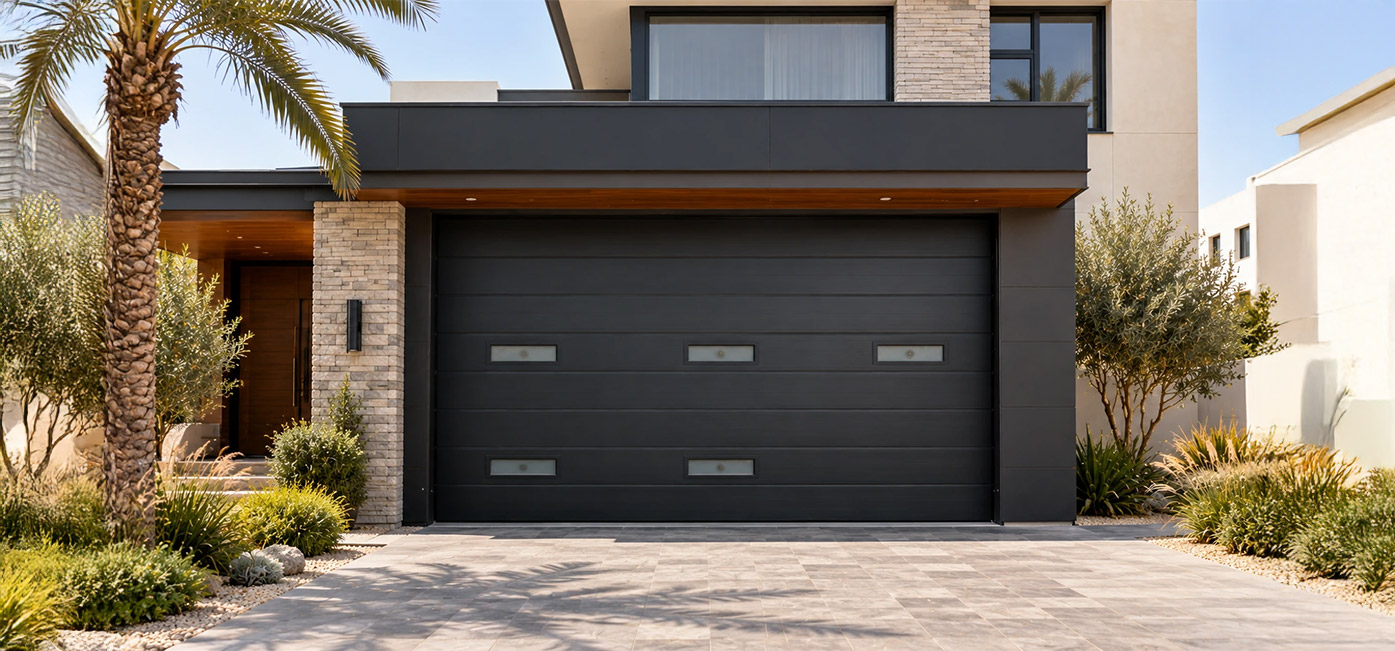



In a UAE summer, where air temperatures regularly exceed 45°C and humidity levels on the coast can climb above 80%, the garage door is one of the largest single openings in the villa envelope and one of the most thermally exposed. A door facing west or south can absorb radiant heat for six to eight hours a day and transfer it directly into the structure.
Insulated cladded garage doors reduce heat transfer, but only when the whole door assembly is correctly specified. The cladding is the finish skin. The insulation comes from the panel core, the perimeter seals, and the frame construction. A door with premium cladding and a poor core, leaking joints, or uninsulated frame sections will not perform thermally regardless of how it looks.
Key Takeaways
- Cladding affects surface heat absorption. The insulated core, seals, and frame determine how much heat passes through the door.
- The whole-door U-value is the figure that matters for the villa envelope. Panel-only U-value is always lower and does not reflect real performance.
- Polyurethane foam cores generally outperform polystyrene at equivalent thicknesses in high-heat conditions.
- Seal condition, joint quality, and surface color each affect heat gain independently of the core specification.
Why the Garage Door Matters in a Hot-Climate Villa
A garage door is one of the largest openings in the residential building envelope, and in UAE villas it typically faces the street, which means it faces the sun for a significant proportion of the day. A standard double garage door can span 5m or more in width and stand 2.2m high, giving it a surface area comparable to a large external wall section.
Attached garages and heat transfer into adjoining rooms
Most UAE villas integrate the garage directly into the building footprint rather than treating it as a detached structure. This means the garage shares walls with living rooms, utility rooms, or internal corridors. Heat that enters the garage through the door conducts through these shared walls into the conditioned interior. The garage becomes a thermal buffer zone that either insulates the interior or amplifies heat transfer into it, depending on how the door is specified.
What an uninsulated door does to cooling load
An uninsulated single-skin steel door offers almost no resistance to heat transfer. Surface temperatures on a dark steel panel facing the afternoon sun in Dubai can reach well above the ambient air temperature. That heat radiates into the garage space, raises the air temperature, and increases the load on any cooling system serving adjacent rooms. Where the garage is mechanically ventilated or cooled itself, the additional heat gain increases operating costs directly. The thermal performance of garage doors UAE designers and engineers should be specifying accounts for this from the outset.
What Makes a Cladded Garage Door Insulated
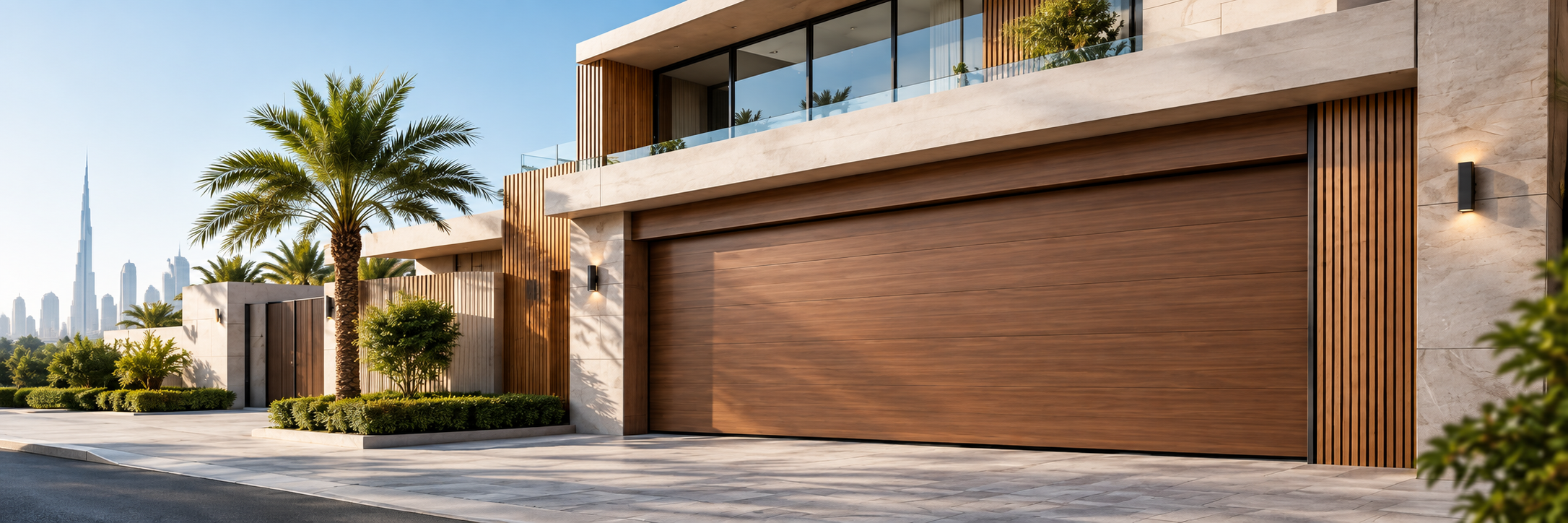
Cladding is the finish skin applied to the face of the door. It is what you see and what matches the villa facade. Insulation is determined by what is behind the face: the panel core, the seals at every joint and perimeter, and the thermal continuity of the frame.
Cladding materials and how they behave in heat
| Cladding material | Surface heat absorption | Humidity behavior |
|---|---|---|
| Aluminum composite panel | Low to moderate depending on finish; light colors reflect significantly more than dark | Stable; does not swell or corrode in coastal humidity with correct coating |
| Steel panel (powder coated) | High on dark finishes; moderate on light | Stable with galvanized substrate and quality powder coat; fixings are the weak point in salt air |
| Timber-effect composite | Moderate; affected more by finish color than material | Moisture-stable composite performs well; real timber is not appropriate for UAE exterior use without intensive maintenance |
| HPL (High Pressure Laminate) | Moderate; UV-stable grades required for exterior use in the UAE | Good moisture resistance; verify UV stabilization rating for the specific product |
The cladding skin affects how much radiant heat the surface absorbs before it reaches the core. A light-colored or reflective finish reduces surface temperature and the starting temperature for conduction.
For details on how facade materials behave across the UAE climate, see the article on cladded garage door facade integration.
Polyurethane foam versus polystyrene cores
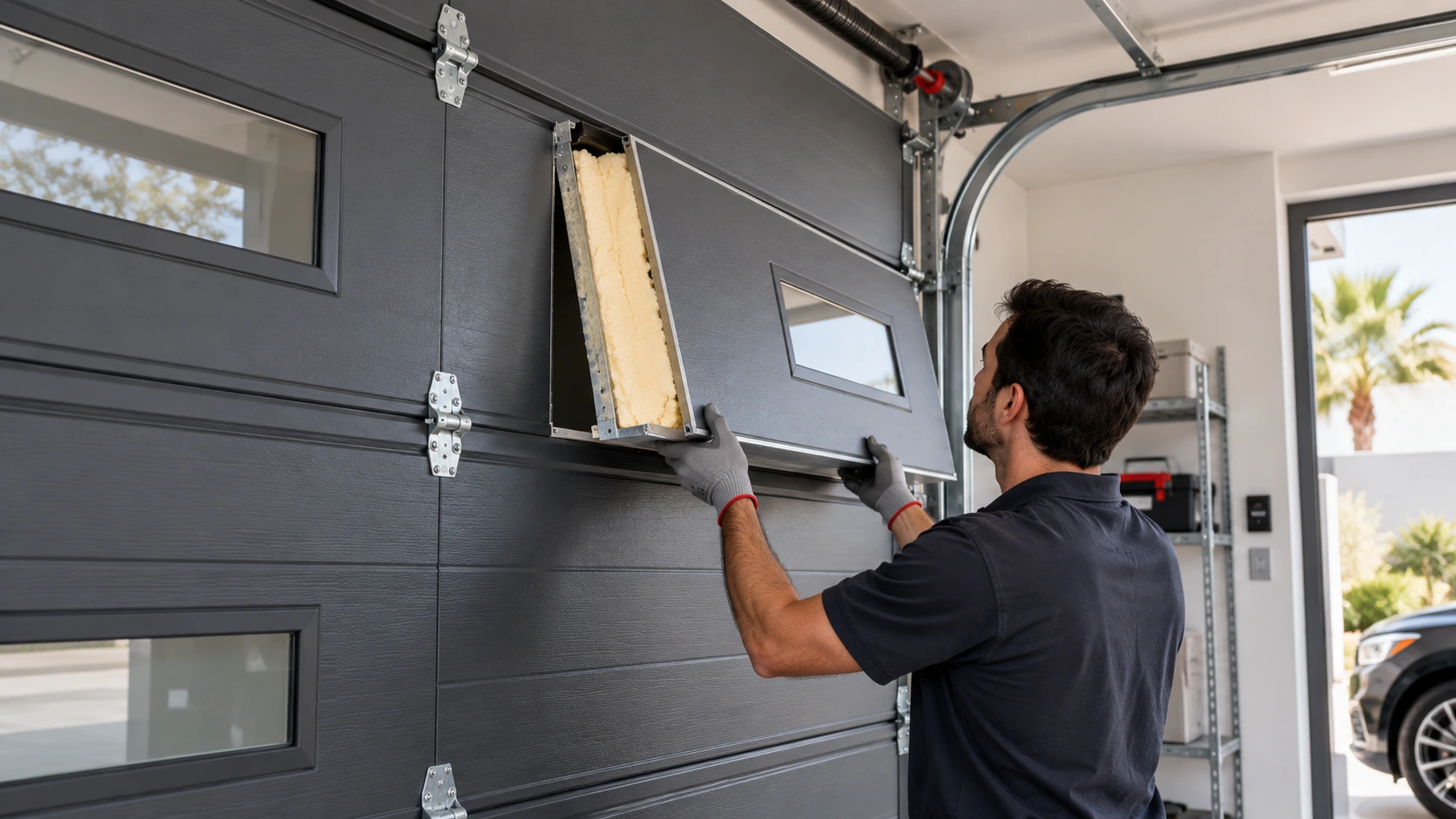
The two most common insulating core materials used in sectional garage door panels are polyurethane (PU) foam and expanded polystyrene (EPS).
Polyurethane foam is injected under pressure to fill the panel cavity completely, bonding to both skins. This bonding adds structural rigidity to the panel as well as insulating it. PU foam achieves a better insulation value per millimeter of thickness than EPS, which matters when the available panel depth is fixed. For UAE conditions where both high heat and high summer humidity are relevant, PU foam’s denser, closed-cell structure also provides better resistance to moisture vapor transmission through the panel.
Polystyrene cores achieve similar insulation values but require a thicker panel to match PU foam performance. EPS is a lower-cost option and performs adequately in moderate climates. In extreme desert heat, the additional panel thickness required to match PU foam insulation values is a genuine consideration.
When a thermal break matters
A thermal break is a low-conductivity material inserted between two metal components to interrupt the conductive path between them. It applies primarily to aluminium frames and glazed door sections, where the aluminum profile would otherwise conduct heat continuously from the exterior face to the interior. It does not apply to every sectional steel panel, where the insulated core already separates the inner and outer skins. If your door specification includes aluminum framing or glazed sections, confirm whether the frame profile is thermally broken.
Garage Door U-Value Explained
U-value measures how much heat passes through a material per square metre for every degree of temperature difference between the two sides. The unit is W/(m²K). A lower U-value means less heat passes through the door.
The distinction that matters in practice is between the panel U-value and the whole-door U-value. Every supplier can quote the panel U-value, which measures only the insulated panel section in isolation. The whole-door U-value accounts for joints between panels, the frame, perimeter seals, any glazed sections, and the actual installed configuration. Because joints and frames are more conductive than the insulated panel, the whole-door figure is always higher than the panel figure. The whole-door U-value is the one that represents actual performance in the building envelope and the one relevant to any green building calculation.
For doors with glazed sections, Solar Heat Gain Coefficient (SHGC) is an additional relevant figure. SHGC measures how much solar radiation passes through the glazing into the interior. A lower SHGC glazing reduces direct solar gain, which is particularly relevant for east and west-facing garage doors in the UAE.
Where Heat Still Gets In: Seals, Joints and Surface Color
Even a door with a well-specified insulated core loses thermal performance at its edges and joints. Understanding where these losses occur helps explain why whole-door U-value is higher than panel U-value and why two doors with identical panels can perform very differently in installation.
The main conductive paths that bypass the insulated core are the perimeter seal between the door and its frame at the sides and top; the bottom seal where the door contacts the floor; the lintel seal at the top of the opening; the horizontal joints between panel sections, where rubber seals compress when the door is closed; and air leakage through gaps at any of these points. Air leakage is measured under EN 12426 and affects both thermal performance and dust ingress, which is a relevant consideration in UAE desert conditions.
Surface color affects how much radiant heat the cladding absorbs before conduction begins. A dark cladding surface in direct sun will reach a substantially higher surface temperature than a light or reflective finish at the same ambient temperature. That temperature difference is the starting point for heat conduction through the panel. Choosing a lighter or reflective finish for a south or west-facing door reduces the peak surface temperature and the associated conductive load. How cladded doors reduce heat transfer is partly a core specification question and partly a color and surface selection decision.
Humidity Resistance and Long-Term Durability
A door that performs well thermally when installed must continue to do so as seals age and surface coatings are exposed to heat, UV, and coastal humidity over years of use.
Corrosion-resistant coatings and galvanized steel substrates are the baseline requirement for UAE and Oman conditions. Fixings are the most common point of early corrosion failure; in coastal locations, 316-grade stainless steel fixings throughout the assembly are the appropriate specification. Hardware including rollers, hinges, spring shaft components, and track brackets all need to be specified for the humidity and salinity exposure of the site.
Humidity-resistant cladded doors use moisture-stable cladding materials rather than materials that swell, delaminate, or lose adhesion when cycling between high and low humidity. Timber-effect composite cladding performs acceptably in UAE humidity conditions when the composite is correctly specified for exterior use. Real timber is the weak point in any cladded door specification for UAE conditions; it requires a maintenance commitment that most residential applications do not sustain, and its thermal and moisture performance degrades faster than composite alternatives.
Seal ageing is a specific concern for heat-resistant cladded doors in the UAE. Rubber seals exposed to sustained heat and UV harden over time, losing their ability to compress and seal. EPDM seals are widely used for their heat and UV resistance in these environments, but any seal should be inspected as part of annual maintenance and replaced at the interval recommended for the specific compound.
Energy Savings and Payback
The energy saving from a correctly insulated garage door is real but depends on the specific configuration of the villa and cannot be stated as a guaranteed percentage.
The estimation method is straightforward: multiply the door area in square metres by the U-value difference between the existing door and the proposed replacement, multiply the result by the number of cooling degree hours in the year, and multiply by the electricity tariff. This gives an approximate annual energy saving in kilowatt hours, which can be converted to a cost figure and compared to the price difference between door options.
Research on insulation performance in hot-arid climates consistently shows that improving the thermal resistance of building envelope components reduces indoor temperature and cooling energy demand. The magnitude of the saving from a single door depends on how much the garage is coupled to conditioned space and how efficiently the building is cooled overall.
Regulatory context for energy efficient garage doors UAE: Dubai’s Al Sa’fat green building rating system sets mandatory envelope performance requirements for residential buildings. Abu Dhabi’s Estidama programme operates separately with its own Pearl Rating system. Whether and how garage doors are treated in the envelope calculation under each system should be confirmed with the project consultant or the relevant authority before making compliance claims.
How to Choose an Insulated Garage Door for Desert Climates
| Specification item | What to ask the supplier | Why it matters |
|---|---|---|
| Panel thickness and core type | PU foam or EPS? What thickness? | Determines insulation value per mm; affects whole-door U-value |
| Whole-door U-value | Is this panel-only or whole-door including frame and seals? | Panel-only figures understate real heat transfer |
| Air and water test class | Tested to EN 12426 (air) and EN 12425 (water)? What class? | Confirms seal performance under pressure; relevant to dust and rain infiltration |
| Seal design and material | What compound? What replacement interval? | Seals age faster in UAE heat; EPDM typically specified for this climate |
| Coating and finish warranty | UV and corrosion warranty for exterior UAE use? | Generic European coating warranties may not cover UAE UV and humidity exposure |
| Installation and service | Is the installer trained by the manufacturer? Is local service available? | Correct installation determines whether the specified performance is actually achieved |
For a complete supplier evaluation framework, see the procurement checklist for door and gate suppliers in the GCC.
For insulated garage doors Dubai projects, the specification process should start with confirmed whole-door U-values and move to the supplier’s local installation and service capability. A specification that is correct on paper but poorly installed achieves a fraction of its rated performance. For garage door insulation in a desert climate, the margin between a well-installed and a poorly installed door is significant.
Dosteen’s full range of heat-resistant cladded doors and insulated sectional doors is available on the garage doors page.
Frequently Asked Questions
1. What U-value should an insulated garage door have in the UAE?
There is no single mandatory U-value figure for garage doors alone. The relevant figure for the villa envelope is the whole-door U-value, which accounts for the frame, joints, and seals as well as the panel. Ask any supplier to confirm whether the U-value they quote is panel-only or whole-door, since panel values are always lower and do not reflect installed performance. For projects subject to Dubai’s Al Sa’fat or Abu Dhabi’s Estidama requirements, confirm the applicable envelope performance target with the project consultant before specifying.
2. Is polyurethane better than polystyrene for desert heat?
Polyurethane foam generally achieves a better insulation value per millimetre of panel thickness and bonds to both panel skins, adding structural rigidity. In the UAE, where available panel depth is constrained and heat loads are high, PU foam is typically the more effective choice. Polystyrene is a lower-cost alternative that can achieve comparable insulation values with a thicker panel section. Confirm which core type is used in the specific product before making a decision.
3. Does cladding make a garage door insulated?
No. Cladding is the finish skin applied to the face of the door. The insulation comes from the panel core, the seals at joints and perimeter, and the thermal continuity of the frame. Cladding material and surface colour affect how much radiant heat the door absorbs before conduction begins, but they do not substitute for an insulated core.
4. Can cladded garage doors handle coastal humidity?
Yes, when the build is correctly specified. The three factors that determine coastal performance are the corrosion resistance of the coating or substrate, the fixings specification (316-grade stainless steel is the standard for coastal locations), and the moisture stability of the cladding material. Timber-effect composite cladding performs acceptably when correctly specified; real timber is the weak point in any coastal specification.
5. How much can an insulated garage door reduce cooling costs?
This depends on the door area, the U-value difference between the existing and replacement door, the number of cooling hours in the year, and how directly the garage is coupled to conditioned space. Multiply door area by U-value difference by annual cooling degree hours by the electricity tariff to estimate the saving. The result will be more significant where the garage shares walls with regularly occupied and cooled rooms.
6. Can an existing garage door be retrofitted with insulation?
Partly. Seal upgrades and insulation panel overlays can reduce heat transfer at the margins, but a fully insulated sectional door is a replacement product rather than an add-on. If the existing door is a single-skin panel without a core, the most effective approach is replacement with an insulated sectional door specified for UAE conditions. A site survey is the practical starting point for confirming which approach is appropriate.
Built to Match. Engineered to Last.
Insulated cladded garage doors reduce heat transfer through the villa envelope, slow the rate at which the garage heats up in summer, and reduce the cooling load on any adjacent conditioned space, provided the whole door assembly is correctly specified. The core, the seals, the frame, and the cladding surface color each play a distinct role. Getting all of them right in a UAE and Oman climate requires confirmed whole-door U-values, climate-appropriate seal compounds, corrosion-resistant fixings, and correct installation by a trained team.
If you are specifying a garage door for a UAE villa and want to confirm the thermal performance of available options, Dosteen’s engineering team can provide whole-door U-value data and carry out a site survey to assess the specific requirements of your opening.