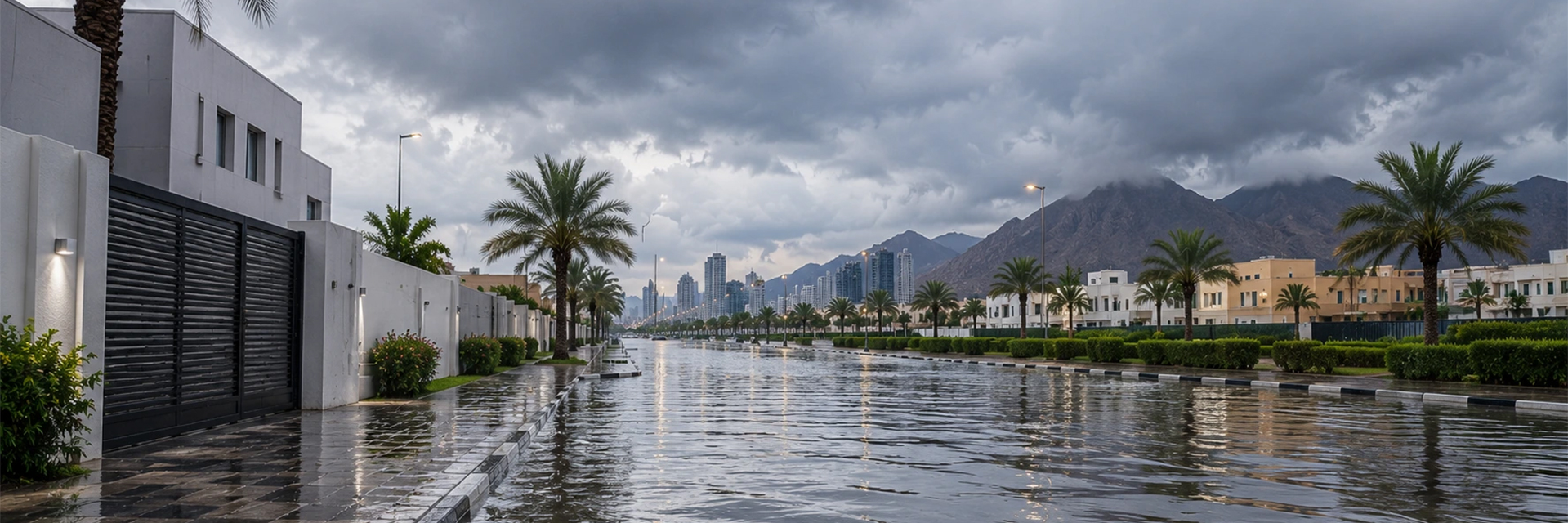



On 16 April 2024, the UAE recorded its heaviest rainfall since meteorological records began in 1949. Dubai received 142mm of rain in 24 hours - equivalent to what the desert city would normally expect in a year and a half. Widespread flooding was reported across all seven emirates, with the highest single-day total recorded at Khatm Al Shakla in Al Ain, reaching 254.8mm in less than 24 hours.
The consequences were significant. Dubai Airport saw more than 1,500 flights delayed or cancelled over three days. Highways became impassable, homes flooded, and businesses across the city shut down. In Oman, at least 19 people lost their lives and over 1,600 individuals were rescued by the Royal Oman Police as floodwaters swept through communities and washed away vehicles.
For property owners and facility managers across the region, the April 2024 event was a turning point. Many discovered, at significant cost, that the assumption that flash flooding was a rare and manageable risk was no longer accurate.
This Was Not a One-Off Event
A similar event occurred in March 2016 when more than 240mm of rain fell on Dubai and Oman in a matter of hours. Research analysing storm systems across the southern Arabian Peninsula from 2000 to 2020 found that these extreme rainfall events are increasing in both frequency and duration, suggesting they will be even more impactful in a warming world.
In the UAE and Oman, 85% and 80% of total populations respectively live in flood-prone and low-lying areas that are highly exposed to flood risk. The combination of rapid urban development, limited natural drainage, and increasingly intense storm systems means that buildings and facilities across both countries carry meaningful flood exposure that most property owners have not yet accounted for.
After the April 2024 storm, property insurance rates in Dubai spiked by approximately 15%, and authorities identified 14 critical areas of the city that flooded, with blocked roads and overwhelmed infrastructure. The financial signal was clear: the market is repricing flood risk upward, and property owners who have not addressed physical flood vulnerability will feel this in insurance premiums as well as in direct damage costs.
What the April 2024 Event Exposed
The flooding revealed several specific vulnerabilities that are directly relevant to property owners and facility managers considering how to protect their buildings.
- Ground-floor openings with no flood protection
The most common and costly failure mode was unprotected ground-floor access points - entrance doors, garage doors, basement car park entries, loading bay openings, and ventilation ducts at ground level. Once water found an entry point, damage to interiors, electrical systems, and stored assets was extensive. - Drainage systems that were never designed for this volume
Even infrastructure specifically designed to handle extreme rainfall events simply could not cope with the intensity of the April 2024 downpour. Buildings that relied entirely on site drainage without any active flood barrier protection were exposed when drainage capacity was exceeded. - Absence of deployable flood solutions for basements and car parks
Basement car parks across Dubai and Sharjah flooded within minutes of water beginning to enter the building perimeter. In most cases, there was no deployable barrier, no automatic system, and no procedure for protecting these spaces. - Reactive response replacing proactive preparation
While the heavy rainfall was well forecast by national meteorological agencies in advance, floodwaters still led to extensive damage to homes, shops, offices, and vehicles. The gap was not in warning time - it was in the absence of physical protection systems that could act on the warning once received.
A Practical Preparation Checklist for Property Owners
The lessons from April 2024 translate directly into a practical checklist for property owners and facility managers evaluating their flood exposure.
- 1. Audit every ground-level opening
Walk the perimeter of your building and identify every opening at or below ground level - entrance doors, service doors, loading bays, garage entries, basement stairwells, ventilation grilles, and drainage points that could reverse-flow during a flood. Each one represents a potential water entry point. - 2. Categorise openings by risk and consequence
Not all openings carry the same consequence if water enters. A service door to a utility room carries lower consequences than a ground-floor electrical room or a basement car park entry serving several hundred vehicles. Prioritise protection based on what is at risk behind each opening, not just the size of the opening itself. - 3. Understand the difference between temporary and permanent flood barriers
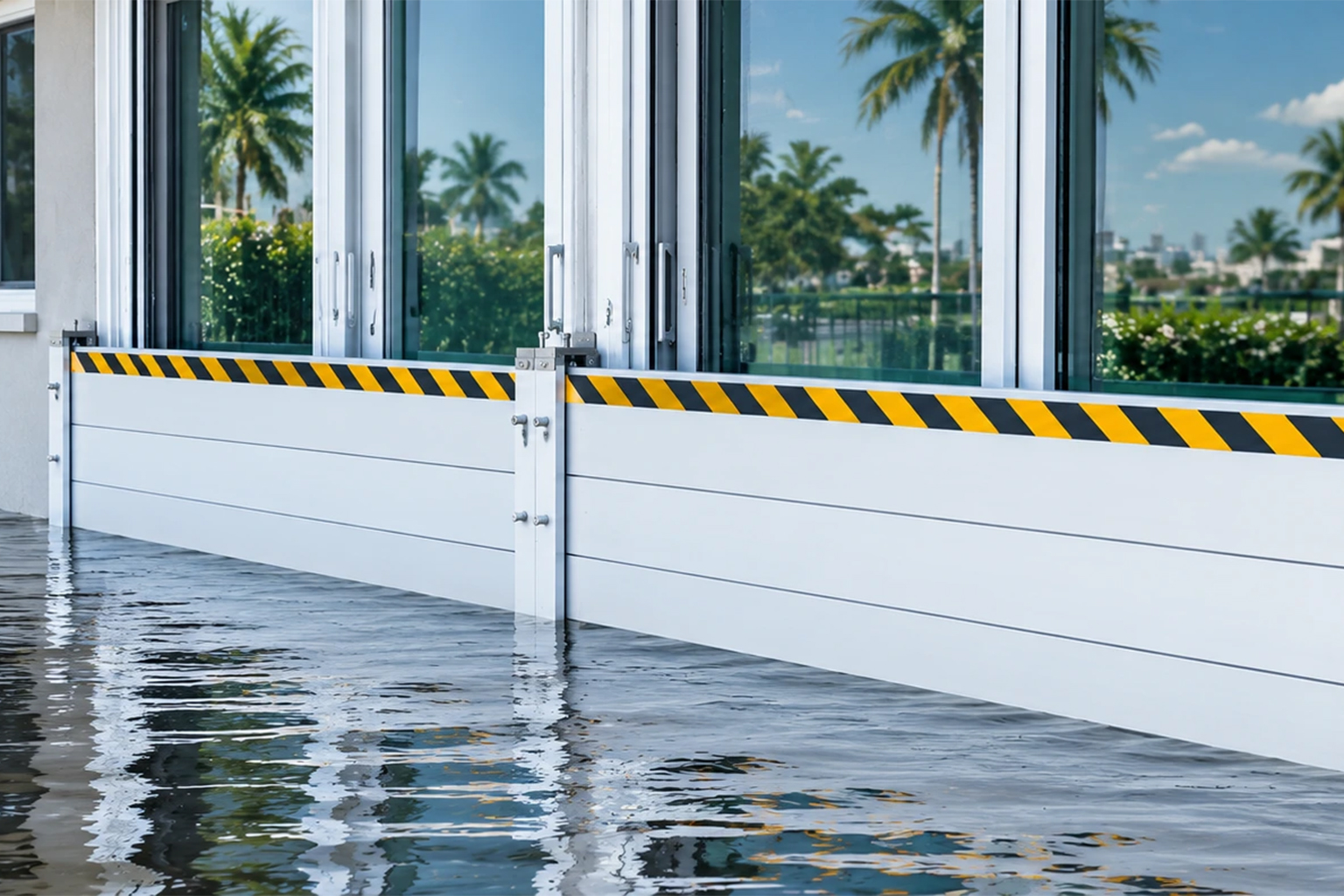
Manual flood barriers are deployable panels that can be installed in minutes when a flood warning is issued. They are cost-effective and practical for openings that are used daily and cannot be permanently sealed. Automatic flood barriers deploy without manual intervention when sensors detect rising water - these are the right choice for properties that may not have staff on-site at the point of an event, or for openings where speed of deployment is critical. Permanent installations provide always-ready protection for the highest-risk access points. - 4. Protect basement and car park entries specifically
Basement car parks represent one of the highest-consequence flood entry points in any commercial or residential building. Water entering a basement at pace is extremely difficult to reverse. A flood barrier at the ramp entry - manual, automatic, or permanent - is the most effective single intervention for protecting basement spaces. - 5. Consider flood defence doors for high-risk or high-value access points
For commercial facilities with regular foot traffic through ground-floor entrances, a certified flood defence door provides permanent protection without disrupting daily operations. These are engineering products with tested watertight seals and pressure ratings, not temporary measures. - 6. Confirm that any system you install is specified for the UAE and Oman environment
The coastal humidity of Oman's Al Batinah coast, the heat and dust of inland UAE, and the saline air of beachfront developments all place specific demands on flood barrier materials. Any flood protection system you install should be manufactured with corrosion-resistant materials and surface treatments appropriate to your site's specific environment. - 7. Check whether your insurance requires physical flood mitigation
After the April 2024 event, property insurance rates in Dubai rose significantly. Some insurers are beginning to factor the presence or absence of physical flood mitigation into their underwriting. Confirm whether your insurer has any requirements or discounts related to installed flood protection before your next renewal.
What to Expect from the Next Event
Climate research suggests that extreme storm systems over the Arabian Peninsula are increasing in duration and are becoming more impactful in a warming climate. The April 2024 event was exceptional. The research indicates it will not remain exceptional for long.
For property owners in Dubai, Abu Dhabi, Sharjah, Muscat, and across the UAE and Oman, the question is no longer whether to consider flood protection. It is how to specify and install it correctly before the next significant rainfall event arrives.
How Dosteen Can Help
Dosteen has been supplying and installing flood protection systems across the UAE and Oman for over 25 years. Our range covers manual flood barriers, automatic flood barriers, flood defence doors, and custom-engineered solutions for complex or non-standard building openings - all manufactured with corrosion-resistant materials appropriate to UAE and Oman conditions.
If you experienced flood ingress in April 2024, or if you want to assess your building's exposure before the next event, our engineering team can carry out a site assessment, identify the highest-risk openings, and recommend the right solution for each one.
FAQs
1. If the storm was forecast in advance, why did it still cause so much damage?
Although the April 2024 storm was well forecast by national meteorological agencies, many buildings lacked physical flood protection systems that could be deployed once warnings were issued. The greatest vulnerability was not the lack of notice but the absence of barriers and other mitigation measures to prevent floodwater from entering properties.
2. What are the most common flood entry points in a building?
The most common flood entry points are ground-floor openings, including entrance doors, garage doors, basement car park entrances, loading bays, service doors, ventilation ducts, and drainage points. Identifying and protecting these access points is one of the most effective ways to reduce the risk of flood damage.
3. What's the difference between manual and automatic flood barriers?
Manual flood barriers are deployable panels that can be installed quickly when a flood warning is issued, making them suitable for openings used daily. Automatic flood barriers deploy without manual intervention when rising water is detected, making them ideal for properties that may be unattended or where rapid response is essential.
4. How should basement car parks be protected from flooding?
Basement car parks are among the highest-risk flood entry points because water can enter rapidly and cause extensive damage to vehicles, equipment, and building infrastructure. Installing a manual, automatic, or permanent flood barrier at the ramp entrance is one of the most effective ways to prevent floodwater from reaching basement levels.
5. What should I check before installing a flood barrier system for my property?
Ensure the flood barrier system is designed for the environmental conditions of the UAE and Oman, including coastal humidity, saline air, heat, and dust. Look for corrosion-resistant materials, appropriate surface treatments, and engineering that matches the specific conditions of your site to support long-term performance and reliability.