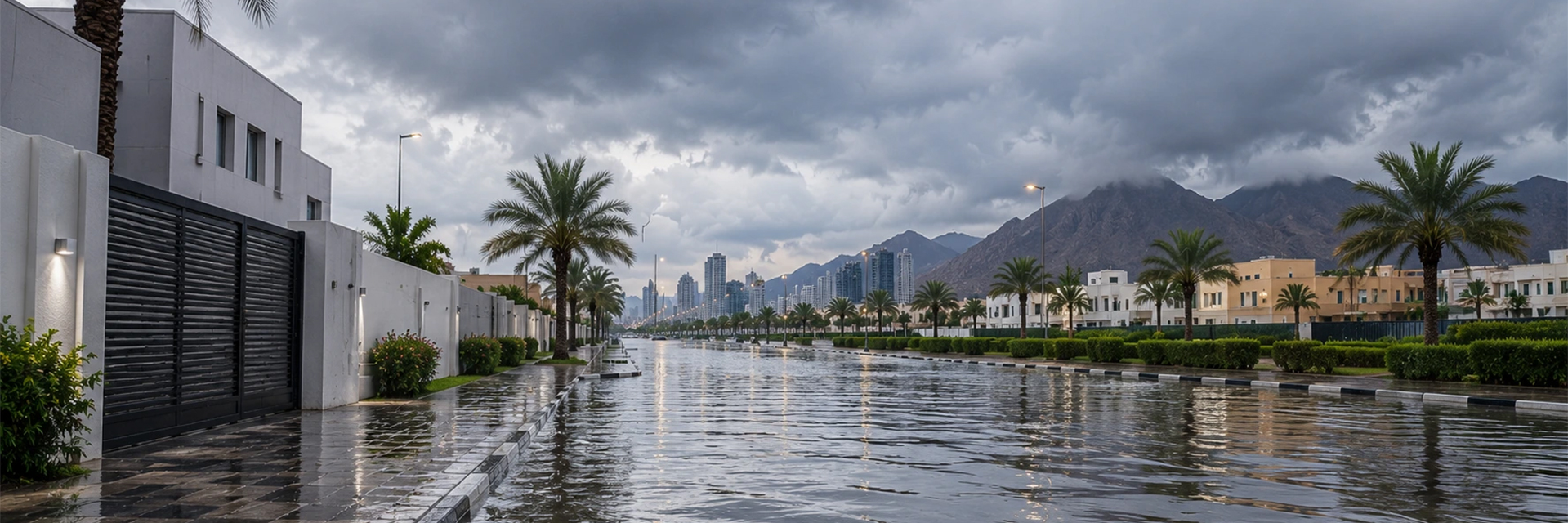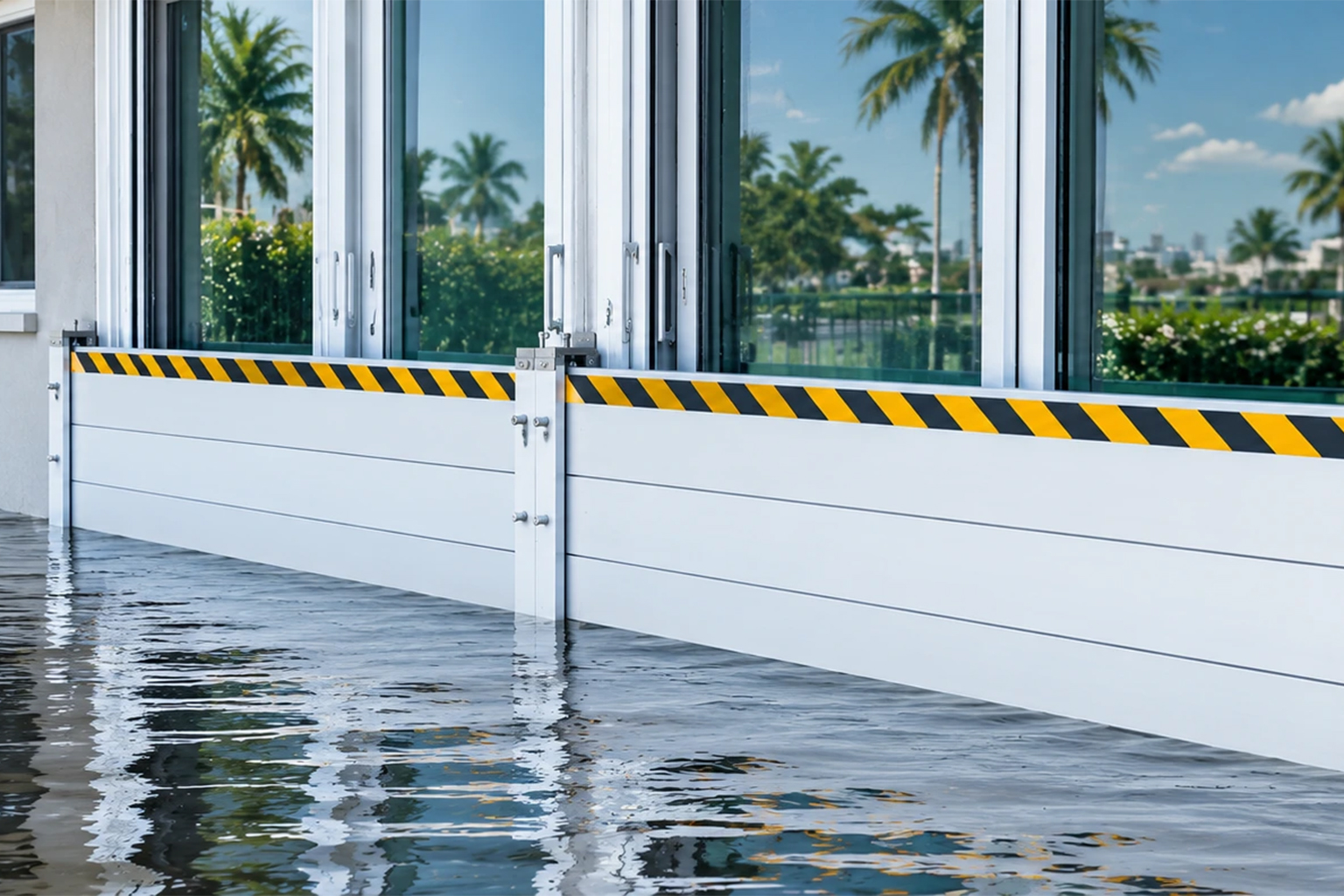



A deployable barrier sits idle for months in heat and salt-laden air, then must seal within hours of a warning. Most products are specified on brochure performance alone. This guide covers types, flood sources, what salt, heat and UV do to materials over time, what the main certifications actually test, how deployment readiness works in practice, and the questions worth asking any supplier before you specify.
Deployable flood barriers (also called deployable flood protection systems) are flood defences stored until a warning is issued, then fitted by people or automatically across doors, garages, ramps or site perimeters to block floodwater. They include portable, removable, modular and automatic designs, and differ from permanent walls or doors because they are only installed when needed.
Key takeaways
- Readiness - trigger, crew, and storage - matters as much as the product itself
- Match the system to the flood source, not to a standard barrier height
- Salt, heat and UV attack seals, fixings and tracks first; ask for evidence, not claims
- FM 2510 and BS 851188 test different things; neither is a Gulf climate test
Deployable flood barriers explained: portable, temporary, removable, modular
"Deployable" is the umbrella term. The others describe how a barrier is built, stored or triggered, so check the mechanism, not the label.
| Term | What it means | Typical use | Watch-out |
|---|---|---|---|
| Portable / mobile | Carried to the opening by hand or trolley | Villa doors, small commercial entrances | Weight and crew availability at short notice |
| Temporary | Installed for an event or season, then removed | Construction sites, seasonal risk areas | Storage space and condition between uses |
| Removable / demountable | Fixed anchorage in place; panels stored and slotted in when needed | Garage ramps, loading bays | Panel storage location and retrieval time |
| Modular | Sections joined to span wider openings | Large commercial entrances, perimeter runs | Joint seals between modules under load |
| Expandable / adjustable | Height or width adjusts to the opening | Mixed-width openings | Seal integrity at adjusted positions |
| Automatic / self-activating | Sensor-triggered; deploys without manual intervention | Unattended sites, basement ramps | Sensor calibration, power supply, false triggers |
Dosteen supplies manual, automatic and portable flood barriers for residential, commercial and industrial applications across the UAE and Oman.
Sudden flash floods: match the system to the flood source
The flood source sets the warning time, depth, velocity and debris load, which together decide the barrier type that is actually fit for purpose.
| Flood source | Where it hits | Warning window | What the system must handle |
|---|---|---|---|
| Urban flash flood (Dubai, UAE cities) | Ground-floor entries, basement ramps, underpasses | Often under two hours from alert to water | Fast manual or automatic deployment; drainage of residual water |
| Wadi flash flood (Northern Emirates, Oman interior) | Villa compounds, roads, industrial compounds near wadis | Can be very short; upstream rain not always visible | Robust panels tolerant of debris and sediment; easy post-event cleaning |
| Cyclone rain and surge (Oman coast - Cyclone Shaheen 2021) | Coastal and low-lying properties, ground floors | Typically 24–48 hours with national warning | Higher head resistance; materials rated for salt-laden wind-driven rain |
| Coastal and storm surge (waterfront sites) | Perimeter openings, basements, service entries | Variable; tide and surge forecasts available | Sustained water pressure over hours; corrosion-resistant fixings throughout |
For a detailed account of what one documented event exposed across the region, see what the April 2024 storm exposed.
How deployable flood barriers work, and where leaks start
A barrier resists water pressure, seals against seepage and transfers load into the surrounding structure. Most failures occur not at the panel face but at seals, joints and adjacent openings that were not considered part of the installation.
The three things a barrier must do
- Load resistance: the panel and its anchorage must withstand the hydrostatic pressure of the water depth it is rated for
- Sealing: the perimeter seal between barrier and frame must remain compressed and watertight under that load for the duration of the flood
- Anchorage: load transfers into the structure through fixings; the surrounding frame and sill must be capable of accepting it
Leak-path checklist: openings to address alongside the barrier
- Adjacent doors and glazing panels with independent sill gaps
- Ventilation grilles, air bricks and mechanical louvres at or below flood level
- Cable and pipe sleeves penetrating the wall or floor
- Floor drains and backflow through drainage runs
- Expansion joints in the structure
- Uplift and seepage at the base of the barrier where it contacts the floor
- Residual water trapped inside after the flood, which still requires pumping
Coastal salinity: what to check in materials, seals and fixings
Chlorides in coastal air attack frames, fixings and tracks first. That damage is often invisible until the barrier is finally needed.
| Component | Salt stress | What to ask for |
|---|---|---|
| Frames and panels | Chloride-driven corrosion at cut edges, joints and coated surfaces | Alloy grade and coating or anodising system rated to the site's corrosion category (ISO 12944) |
| Fasteners and anchors | Galvanic and crevice corrosion, particularly where dissimilar metals contact | 316-grade stainless steel commonly specified for coastal sites; ask how dissimilar metal contact is isolated |
| Seals | Salt and ozone degradation hardening the rubber over time | EPDM is widely used for salt and ozone resistance; ask for the seal compound and replacement interval |
| Tracks and sockets | Salt crust and windblown sand accumulation in the socket or channel | Ask about protective caps, drainage provision and the recommended cleaning routine between events |
| After-event care | Salt residue accelerates corrosion after barrier removal | Confirm the rinse-down and inspection procedure following any deployment |
Heat and UV: why seals and fabrics age first
Heat and UV do not typically break the panel. They harden the seal, degrade the coating and, for fabric or inflatable types, break down the material structure - all while the barrier sits in storage.
Dormant, then critical
A seal that has been compressed in heat for months may have taken a permanent set by the time it is needed. This is called compression set: the rubber no longer springs back to its original profile when the barrier is removed, reducing its effectiveness at the next deployment. Sun-exposed storage accelerates this process significantly. Thermal expansion at joints between panels or between the barrier and its frame can also create gaps if the design has not accounted for the temperature differential. For fabric and inflatable barrier types, UV-stabilised materials are a minimum requirement, not an optional specification.
Heat-resistant flood barriers: what the claim should rest on
Ask any supplier for UV or accelerated-ageing test reports and seal compression-set data specific to the product, not generic material data sheets. FM 2510 includes ageing tests as part of its scope, making it the more informative standard for this climate than one that tests performance alone. For detail on how heat, UV and coastal humidity affect doors and gates more broadly, the linked article covers the same material degradation mechanisms across a wider range of building products.
Certification: what FM 2510 and BS 851188 tell you, and what they don't
No single standard proves a barrier will perform under Gulf climate conditions. The two most commonly cited benchmarks test different things.
| Standard | Covers | Strong On | Limits |
|---|---|---|---|
| FM 2510 (FM Global) | Performance under flood load plus component and material durability including salt spray and ageing | Durability evidence alongside performance; widely accepted by insurers | US-origin; applies only to the exact tested configuration |
| BS 851188 Part 1 (building products) | Leakage resistance and structural load | Leakage at the tested head height and impact loading | Does not test material longevity or environmental degradation |
| BS 851188 Part 2 (perimeter barriers) | Larger deployable perimeter systems | Seepage and impact for temporary perimeter use | Does not test material longevity or environmental degradation |
Three distinctions worth checking on any certificate
- "Tested to" means a third party ran the test; "certified to" means a certification body confirmed conformity; "designed in accordance with" means neither
- Check the certificate scope: it applies only to the specific product, height and configuration that was tested - confirm your opening falls within it
- Check the certificate date; seals and materials specified on an older certificate may have been substituted since
Rapid deployment for sudden flash floods: trigger, crew, storage and drills
"Installs in minutes" covers only the final step. Total deployment time is trigger plus mobilisation plus installation - and the first two are determined by preparation, not by the product.
| Alert level | Recommended action |
|---|---|
| NCM Yellow alert ("be aware") | Check the kit is accessible; inspect seals and fixings |
| NCM Orange alert ("be prepared") | Stage the kit at each opening; brief the crew; deploy at highest-consequence openings |
| NCM Red alert | Barriers should already be installed; never deploy into moving water |
For Oman, follow NCEM national early-warning alerts and any guidance issued by the relevant governorate authority.
Deployment readiness checklist
- Write a numbered deployment sequence for every protected opening - not a general procedure
- Store barriers at the point of use in shaded, accessible locations; not in a distant storage room
- Designate at least two trained people per opening, with a named backup for each
- Run a full drill before the start of the rainy season each year
- Specify automatic barriers for any opening that will be unattended during a flood event
- Do not deploy where doing so places the crew in moving water or diverts water onto neighbouring property
Choosing the right system: which barrier for which property
Choose by opening size, daily use, warning time and staffing availability - not by the height figure in a brochure.
| Property or opening | Main risk | Suggested approach | Note |
|---|---|---|---|
| Villa or townhouse entrance door | Urban flash flood; limited warning | Portable or removable demountable panel | Crew size and storage location are critical |
| Residential garage door | Urban flash flood; basement below | Demountable or automatic system across the full opening width | Drainage of residual water once flood recedes |
| Basement car park ramp | Rapid inflow; high consequence | Automatic self-activating system | Sensor reliability and power backup are essential |
| Commercial entrance (with egress requirement) | Flash flood or coastal event | Barrier system compatible with life-safety egress | Coordinate with fire safety consultant |
| Industrial loading bay | Debris-laden wadi or urban flood | Heavy-duty demountable system with robust bottom seal | Post-event cleaning and seal inspection |
| Waterfront property | Coastal surge and cyclone rain | Engineered deployable systems for coastal properties with S4-grade materials | Corrosion category confirmation required |
| Large site or critical infrastructure | Sustained flood event | Combination of permanent and deployable perimeter measures | Reference public-sector precedents such as the Dubai Metro FloodWall programme |
What drives cost, lifecycle and insurance impact
The main cost drivers for a deployable flood barrier are opening size and the engineering depth required, the level of certification evidence supplied, custom fabrication for non-standard openings, any anchoring or structural works, storage provision and initial training, seal replacement over the product life, and whether a service and inspection contract is included.
Sandbags are sometimes proposed as an alternative. They are labour-intensive to source and deploy at short notice, single-use, prone to leaking at the base, and generate contaminated waste that requires disposal. They are not a substitute for a specified system on any opening where repeated deployment is anticipated.
On insurance, the impact of installed flood protection on premiums and excess terms varies by insurer and policy. Ask your insurer directly whether installed flood barriers affect your cover before purchasing or specifying.
Questions to ask a supplier before you specify
When evaluating deployable flood barriers, the quality of the supplier's answers to the following matters as much as the product specification itself.
- Which standard is this exact configuration certified to, and what is the certificate's scope, height, configuration and date?
- What salt-spray test hours, corrosion category classification and UV or accelerated-ageing data back the materials and seals?
- What is the seal compound and what is its recommended replacement interval in Gulf heat?
- How many people are required to deploy, and how long does it take? Has this been demonstrated on a comparable opening?
- What provision is made for adjacent vents, drains, glazing and residual water that remains inside after the barrier is removed?
- Where is the product manufactured, and what is the lead time for replacement seals and parts to reach the UAE and Oman?
- What training, pre-season drills and periodic inspection are included or available?
- Can you share documented GCC installations with comparable opening types?
For a broader framework applicable to any building systems supplier, see the procurement checklist for door and gate suppliers in the GCC.
How Dosteen approaches deployable flood protection in the UAE and Oman
Dosteen supplies manual, automatic and portable flood barriers for residential, commercial and industrial properties across the UAE and Oman. Systems are custom fitted to doors, garages, vents and driveways, with permanent and removable installation options depending on the site's requirements and operational pattern. Materials are treated for heat, humidity and coastal salinity conditions. Service contracts and periodic inspections are available to maintain system readiness between flood seasons. Dosteen has been operating in the UAE and Oman for over 25 years, with manufacturing facilities in both countries providing direct access to parts and technical support.
Explore Dosteen's flood protection systems or request a site assessment to discuss your specific opening and risk profile.
Frequently Asked Questions
1. How quickly can deployable flood barriers be installed before a flash flood?
Installation time depends on the barrier type, opening size and crew preparation. A pre-staged removable system on a single door can typically be installed within a few minutes by a trained two-person crew. Automatic systems deploy without manual action once triggered. Total readiness time - from alert to installed barrier - depends on crew mobilisation and storage location as much as the product itself.
2. Are flood barriers built for UAE and Oman conditions different from standard products?
They should be, though not all are. The UAE and Oman present a specific combination of high UV exposure, extreme heat, coastal salinity, and sudden intense rainfall after long dry periods. These conditions degrade seals, coatings and fixings in ways that a standard product tested in a temperate climate may not reflect. Ask suppliers for specific material and seal data relevant to these conditions rather than accepting general performance claims.
3. What is the best flood barrier for heat and flash floods in the UAE?
There is no single answer, as the right barrier depends on the opening type, warning time available, staffing, and flood source. For most residential openings, a removable demountable panel or automatic system with seals rated for heat and UV offers the most practical combination of performance and deployability. For unattended openings, automatic systems remove the dependence on crew availability entirely.
4. Do I need certified flood barriers in the UAE or Oman?
No UAE or Oman regulation mandating a specific flood barrier certification standard has been identified at the time of writing. However, some insurers, project consultants and authority requirements may specify a standard. Confirm what is required for your specific project or property with your insurer and the relevant authority before proceeding.
5. Is a flood barrier enough to protect a property on its own?
A barrier addresses the primary entry point but is not sufficient on its own. Adjacent openings including vents, drains, pipe and cable sleeves, and floor drainage all require separate consideration. A site assessment covering all ground-level openings gives a more accurate picture of the protection level achievable.